
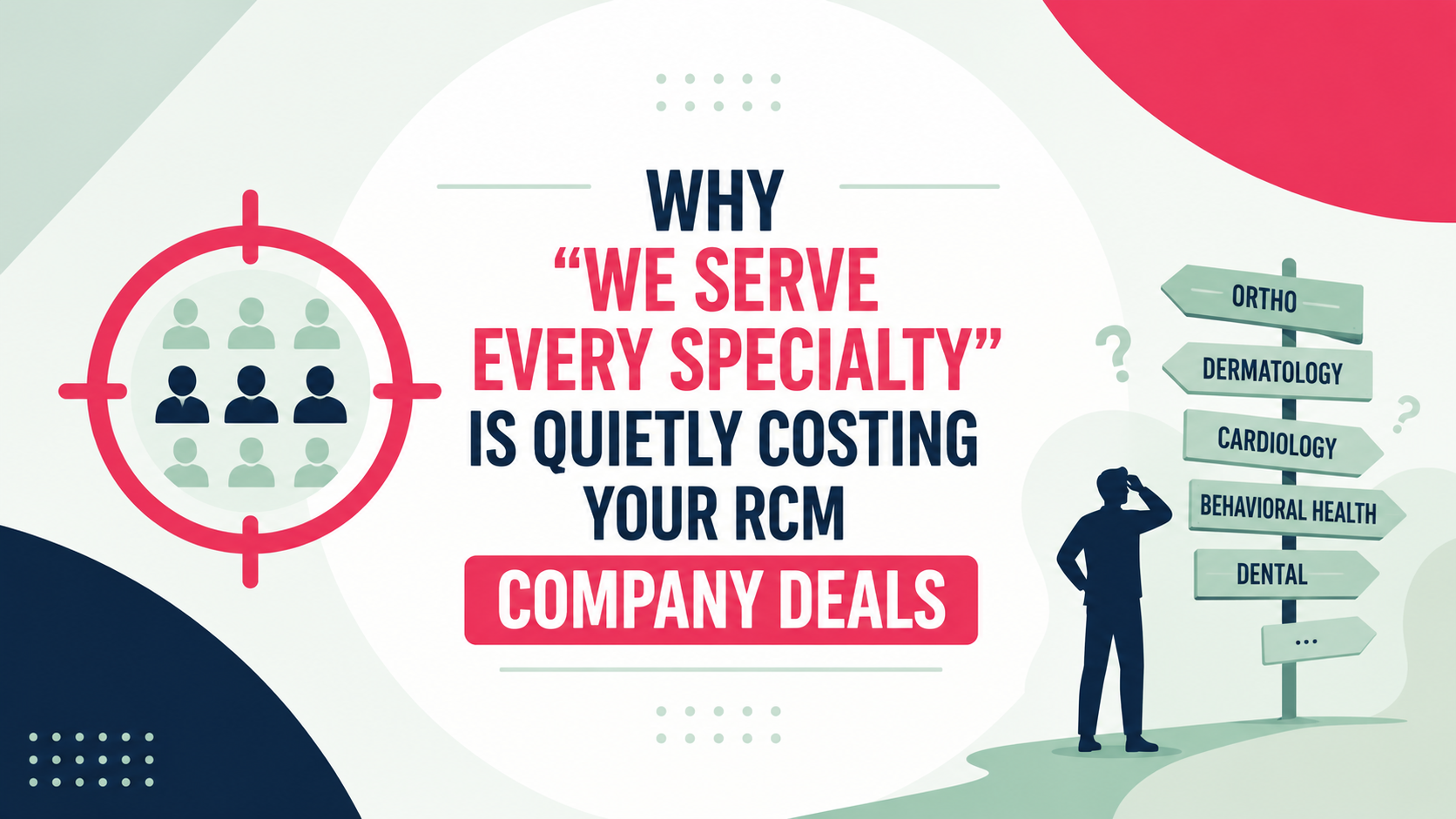
“We serve practices of all specialties and sizes.” It might be the most expensive sentence on your website. It feels like the safe choice — why narrow the funnel? — but to the buyer on the other side, it reads as a quiet admission: we are not built specifically for you.
In a market where every RCM company offers roughly the same services, generalist positioning is no positioning at all. And the cost shows up where you can’t see it: in the deals you never hear about, lost to a competitor who simply sounded like the obvious choice for that one practice.
The generalist’s curse
When you’re for everyone, you’re memorable to no one. A practice administrator evaluating partners isn’t looking for the company that can technically handle their billing. They’re looking for the company that clearly already understands their world — their payers, their denials, their specialty’s peculiarities.
Put two companies in front of a gastroenterology group. One says “comprehensive RCM for all specialties.” The other says “we specialize in GI billing.” Same capabilities, same price. The GI group picks the specialist almost every time — not because the generalist is worse, but because the specialist removed all the buyer’s doubt in four words.
The fear that keeps founders generic
Every RCM founder who hears “niche down” has the same reaction: if I position around one specialty, I’ll turn away all the other business I could win. It’s a reasonable fear. It’s also based on a misunderstanding of what positioning actually does.
Positioning is the message at the front door. It is not a contract that forbids you from serving anyone else. A pediatric practice that finds your “GI billing specialist” page and calls anyway is not turned away — you simply tell them yes. You lose nothing by leading with a specialty. You lose deals by leading with nothing.
Not sure what your lead specialty should be? RCM Lens helps RCM companies find the positioning already hiding in their book of business — and build the pages and content that make it land. Start a conversation at rcmlens.com.
How to specialize on the surface while serving broadly underneath
- Choose a lead specialty
Look at your existing book of business. Where do you already have depth, results, and reference-able experience? That’s your lead specialty — the one you put at the front of the website, the LinkedIn content, and the cold outreach. It doesn’t have to be the only thing you do. It has to be the first thing you say.
- Build specialty-specific pages
A single “Services” page that lists everything signals depth in nothing. Instead, build dedicated pages for your two or three strongest specialties, each speaking that specialty’s language — its common denial reasons, its payer mix, its credentialing quirks. This is also how you win the searches that actually convert, like “outsource gastroenterology billing,” which we covered in the SEO keywords piece.
- Show proof in the specialty’s vocabulary
Generic proof (“we improve collections”) convinces no one. Proof framed in a specialty’s terms convinces immediately: a denial-rate improvement on the codes that specialty actually bills, an AR turnaround on that specialty’s typical payers. Specificity is what makes a buyer think these people have done this before — for someone like me.
The compounding effect of focus
Specialization doesn’t just win the next deal. It compounds. A reputation as “the GI billing people” travels through specialty networks where administrators talk to each other. It makes your content sharper because you’re writing for a defined reader. It makes your SEO stronger because you’re ranking for intent-rich terms instead of fighting the entire industry for “medical billing services.” Each focused win makes the next one easier.
Generalist positioning does the opposite — it forces you to compete on price and proximity, because you’ve given the buyer no other reason to choose you. The narrower message is the one that grows the broader business.