
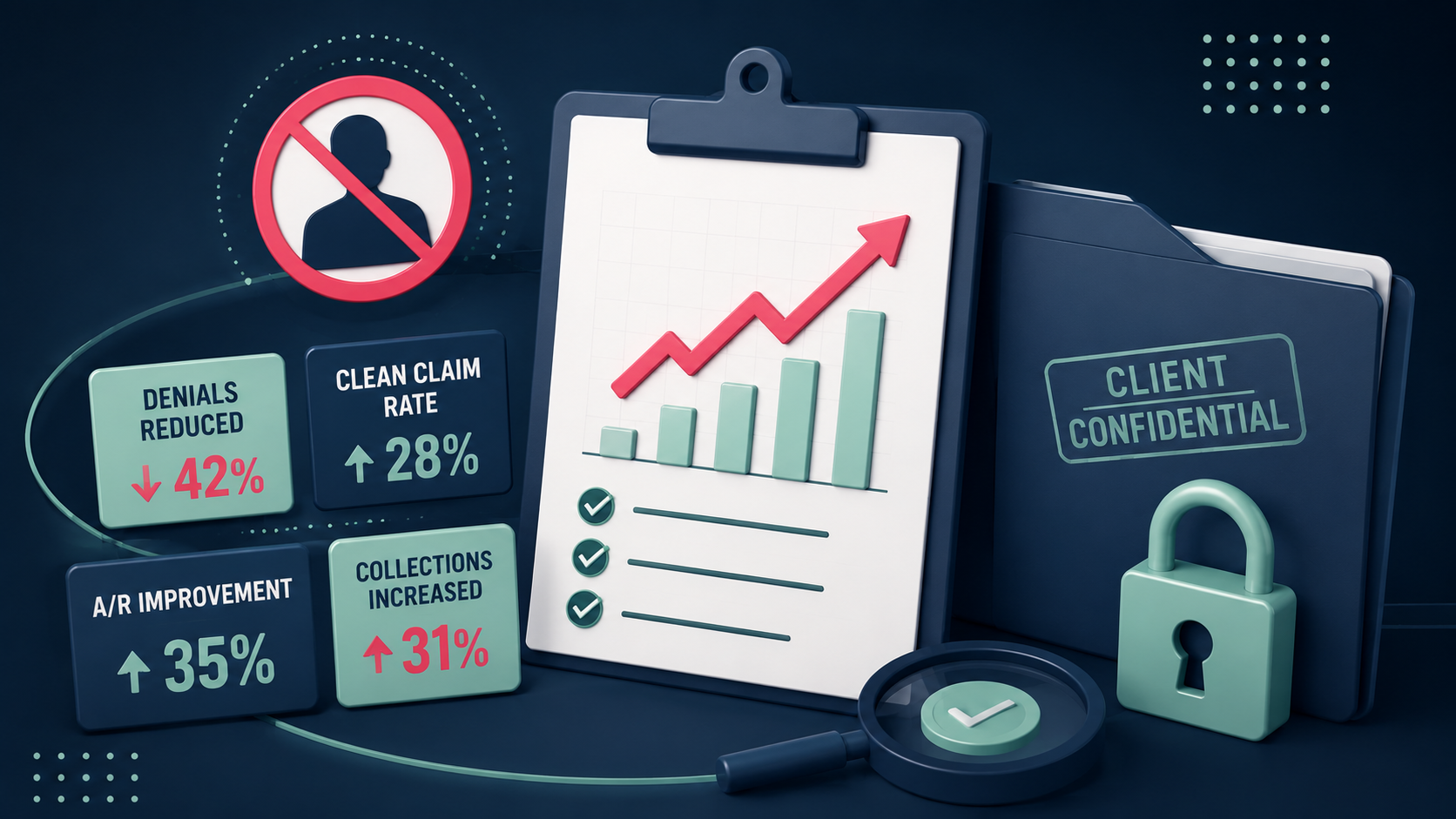
Your best case study is under NDA. Your happiest client won’t go on the record. Healthcare confidentiality, competitive sensitivity, and plain caution mean the proof that would close deals tomorrow is locked in a drawer. So your website falls back on the only thing left: “we improve collections and reduce denials” — a claim with nothing behind it.
This is the RCM credibility paradox. The companies with the strongest results often look the least credible online, because the results they’re proudest of are exactly the ones they can’t name. Meanwhile the buyer, who has been burned before, is reading your unproven claims with a healthy dose of skepticism.
Why “trusted by leading practices” convinces nobody
The reflex is to gesture at proof without specifics: “trusted by leading practices nationwide,” “proven results,” “clients love us.” None of it lands. Vague proof reads as no proof — worse, it reads as the thing companies say when they don’t have any. The buyer mentally files it next to “industry-leading” and moves on.
The good news: you don’t need a single client name to build real credibility. You need specificity, and there are at least five forms of it available even under the tightest confidentiality.
Five kinds of proof that don’t require a name
- Anonymized but specific metrics
A name is not what makes a result believable — specificity is. “A 14-provider GI group in the Southeast cut its denial rate from 12% to 4% in six months” convinces, even with no practice named. The detail does the work: the size, the specialty, the region, the timeframe, the before-and-after. Anonymized and specific beats named and vague. Strip the identity, keep the numbers.
- Process transparency
If you can’t show outcomes by name, show how you work. A clear walkthrough of your onboarding, your reporting cadence, your denial-management workflow, your escalation path — this is proof of competence the buyer can evaluate directly. Most RCM companies hide their process behind “contact us.” Showing it is a trust advantage precisely because so few do.
- De-identified case studies
A full case study still works without identifying details. Set the scene (specialty, size, the problem), describe what you found and what you changed, and report the result with real numbers. Label it honestly — “client details withheld for confidentiality” — which itself signals you take confidentiality seriously, a quality this buyer values.
- The proof that can be named
Some signals don’t require client permission at all. Google reviews. A named testimonial from an individual (a billing manager willing to be quoted as a person, even if the practice isn’t named). LinkedIn recommendations on the founder’s profile. Third-party validation carries weight precisely because it lives somewhere you don’t control. Ask for it deliberately — most satisfied clients will say yes to a quote when they’d say no to a logo.
- Demonstrated expertise
When client proof is scarce, founder and team proof fills the gap. Depth of experience, a clear point of view, content that shows you understand the work from the inside — this is why thought leadership matters more for RCM companies than for almost any other B2B category. If you can’t show what you did for a named client, show that you understand the problem better than anyone else competing for the deal.
Sitting on results you can’t talk about? RCM Lens helps RCM companies turn confidential wins into credible, compliant proof — anonymized case studies, metric callouts, and review systems that build trust without breaking a single NDA. Talk to us at rcmlens.com.
How to get a shy client to say yes
Most clients refuse a testimonial because the ask is too big — they hear “put your practice’s name on a marketing page” and decline on instinct. Shrink the ask. Offer to anonymize. Write the quote for them to approve rather than asking them to compose one. Ask for a metric and a sentence, not a glowing paragraph. The yes rate on a small, de-identified ask is far higher than on the version most companies lead with — and one approved anonymized result is worth more than a page of “proven solutions.”